Fabula est scintilla quae arti lucem donat.





Fabula est scintilla quae arti lucem donat.


PREVIEW THE ALBUM - SPOTIFY PLAYER
THE ALBUM
A FILM TOLD THROUGH SOUND
The Magnificent Mile was conceived as a film told through sound.
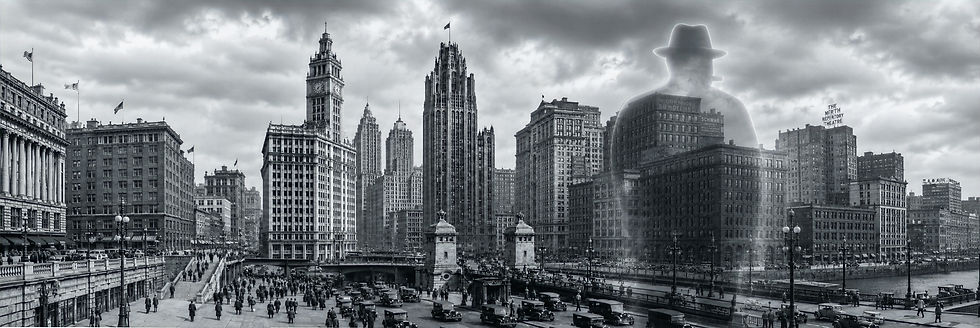
Michigan Avenue, Chicago’s great artery, was the stage where empire and myth were built, and it became the backbone of this album.
The street is not a backdrop but a protagonist: a living corridor where ambition, violence, glamour, and downfall walk in sequence. Each song is a chapter, each arrangement a scene unfolding in time. Together they form a score that is both biographical and mythological, a meditation on power and fragility, on the rise and inevitable fall of a man who became legend.
The journey begins in New York with Scarred, a raw portrait of a young Al Capone earning the nickname Scarface. A soul‑jazz overture carrying the grit of back‑alley fights and the weight of a name that would follow him forever.
From there, the sound travels west, swelling with swagger and the atmosphere of the 1920s as he joins Johnny Torrio in Chicago. The palette remains resolutely jazz: the piano leads the dance, in solo and in dialogue with the band, and what you feel is less the conquest of a crowd than the ambition of a man opening himself to new horizons, not yet knowing what awaits him.
At its peak, Steel & Silk captures the paradox of his reign: brutality wrapped not in elegance but in bling, ostentatious luxury, and gaudy excess. The arrangement is lush, orchestral jazz laced with blues, a portrait of a man building his empire on charm, fear, and the blinding shine of his own extravagance.
But the album pauses at Chapter 7, where the light turns toward his family. Mae sings a lullaby to her son Sonny, a gentle melody drifting like a mother’s breath, softening the edges of the story. The music turns inward: delicate notes, tender harmonies, intimacy replacing grandeur. A reminder that even empires rest on fragile foundations, and that behind the myth there was a child falling asleep to the sound of his mother’s voice.
Then comes the turning point. Chapter 8 unfolds in cinematic tones: violins and clarinet sketching the long corridors of the courtroom. The atmosphere is austere, echoing marble and heavy verdicts. Justice becomes the narrator. A sovereign voice singing judgment, not as mere punishment but as destiny. The music is stripped yet majestic, a reminder that every empire eventually meets its reckoning.
Incarceration follows, not heavy but ironic. The rhythms are light, almost carefree, tinged with the style of the 1930s: playful swing, ironic melodies, music that dances even as the walls close in. The banjo, which Capone learned in prison, adds an unexpected touch, a spark of whimsy at the heart of the fall.
It is the sound of a man who once ruled a city now confined, yet still carrying himself with bravado. You hear both the absurdity and the inevitability of the downfall.
And finally, the last chapter arrives like end credits. Not a dirge, but a meditation: gospel‑infused soul, the whole band gathering to reflect on the final mile, the last breath, the myth of a life lived in iron and shadow. The voices rise together, not in mourning but in reverence. A chorus that feels both communal and eternal. It is not about death, but about legacy, about the way myth lingers long after the man is gone.

THE STORY
TEN CHAPTERS ONE LEGEND
The Magnificent Mile is not music beside the story, but the story itself, written in soul, jazz, and cinematic restraint.
A sonic avenue where each chapter holds a scene, and each scene a truth you thought you had forgotten.
It is the sound of rise and fall, the myth carried in melody and rhythm. A film in music.
CHAPTER 01 -
Scarred (Origins Brooklyn)

Alphonse Gabriel Capone was born in 1899 in Brooklyn, New York, the son of Italian immigrants who had come to America seeking opportunity. His father was a barber, his mother a seamstress; hardworking, modest people who hoped their children would climb higher than they had. But Brooklyn at the turn of the century was a tough place to grow up, and young Al quickly learned that survival meant toughness, not tenderness. By the age of 14, Capone had dropped out of school after striking a teacher who had insulted him. That moment marked the end of his formal education and the beginning of his life on the streets. Brooklyn’s neighborhoods were alive with gangs; the Junior Forty Thieves, the Bowery Boys, and eventually the notorious Five Points Gang. These groups offered camaraderie, protection, and a path to money and power. Capone, sharp and ambitious, fit right in. It was during his teenage years working as a bouncer at the Harvard Inn, a saloon in Coney Island, that he earned the nickname he despised: Scarface. One night, after making a crude remark to a woman, her brother slashed Capone’s face with a knife, leaving three jagged scars that ran from his left cheek to his jaw. Though he tried to hide them with makeup or by turning his head in photographs, the scars became his most recognizable feature. To Capone, they were a reminder of youthful recklessness, and a mark that tied him forever to the underworld. Despite the humiliation, the incident hardened him. He carried himself with more swagger, more defiance, and more determination to rise above the petty street fights of Brooklyn. The boy who had once been just another immigrant kid was now carving out an identity, one that would eventually dominate Chicago and the American imagination.
CHAPTER 02 -
Five Points to Chicago

After the scars of Brooklyn marked him, Al Capone’s next chapter unfolded in the dense, dangerous streets of Manhattan. In his late teens, he gravitated toward the Five Points Gang, one of New York’s most notorious criminal organizations. The gang was a proving ground for ambitious young men, a place where petty street fights gave way to organized rackets, and where loyalty and violence were the currency of survival. Capone quickly distinguished himself. He was tough, but more importantly, he was shrewd. He learned how to balance intimidation with charm, how to win allies as well as battles. The Five Points Gang exposed him to the mechanics of organized crime: protection rackets, gambling dens, and the underground economy that thrived in prohibition‑era shadows. It was during this time that Capone crossed paths with Johnny Torrio, a seasoned gangster who recognized the young man’s potential. Torrio was everything Capone aspired to be, disciplined, calculating, and respected. Where others saw a brash kid with scars, Torrio saw a future lieutenant. When Torrio relocated to Chicago to expand his operations, he invited Capone to join him. For Capone, the move was more than geographic; it was transformational. Chicago was a city bursting with opportunity for organized crime, a booming metropolis with corrupt politicians, thirsty citizens, and endless demand for illegal liquor. Capone left behind the cramped tenements of New York and stepped into a new world where Torrio’s mentorship would refine him. Under Torrio’s guidance, Capone learned to run businesses disguised as legitimate fronts, to negotiate with city officials, and to orchestrate violence not as chaos but as strategy. By the time Torrio handed over the reins of his empire, Capone was no longer the reckless Brooklyn brawler. He had become a rising figure in Chicago’s underworld, a man scarred by youth but sharpened by mentorship, ready to carve his name into history.
CHAPTER 03 -
Blood & Bootleg (Rise of the Outfit)

When Johnny Torrio stepped aside in 1925 after surviving an assassination attempt, Al Capone inherited more than just a criminal organization, he inherited a city. Chicago was already a place of opportunity for the underworld, but under Capone’s leadership, the Outfit became a sprawling empire that touched nearly every corner of urban life. Capone understood that Prohibition was not a moral crusade but a business opportunity. While the government outlawed alcohol, the people still craved it, and Capone was ready to supply. Breweries and distilleries operated under his control, trucks carried liquor across state lines, and speakeasies flourished under his protection. The profits were staggering: by the late 1920s, his empire was said to be worth more than $100 million a year, a fortune that dwarfed legitimate enterprises. But liquor was only the beginning. Gambling houses, brothels, and protection rackets expanded his reach. Businesses paid for “insurance” against destruction, and those who refused often found their shops smashed or burned. Capone’s men collected debts, enforced loyalty, and ensured that rivals were kept in check. Violence was not random, it was calculated, a tool to maintain dominance. At the same time, Capone cultivated a public image that softened his brutality. He donated to charities, funded soup kitchens during the Depression, and presented himself as a man of the people. Newspapers painted him as both villain and benefactor, a paradox that made him infamous but also strangely admired. Behind the scenes, his influence seeped into politics and law enforcement. Judges were bribed, police officers were paid off, and city officials turned a blind eye. Chicago became a city where Capone’s word carried as much weight as the mayor’s. The peak of his reign was marked by blood. The most notorious example came on Valentine’s Day in 1929, when seven members of a rival gang were gunned down in a North Side garage. The massacre shocked the nation and cemented Capone’s reputation as the ruthless king of Chicago.
CHAPTER 04 -
Shadow Saint (Public Persona / Fear & Charity)
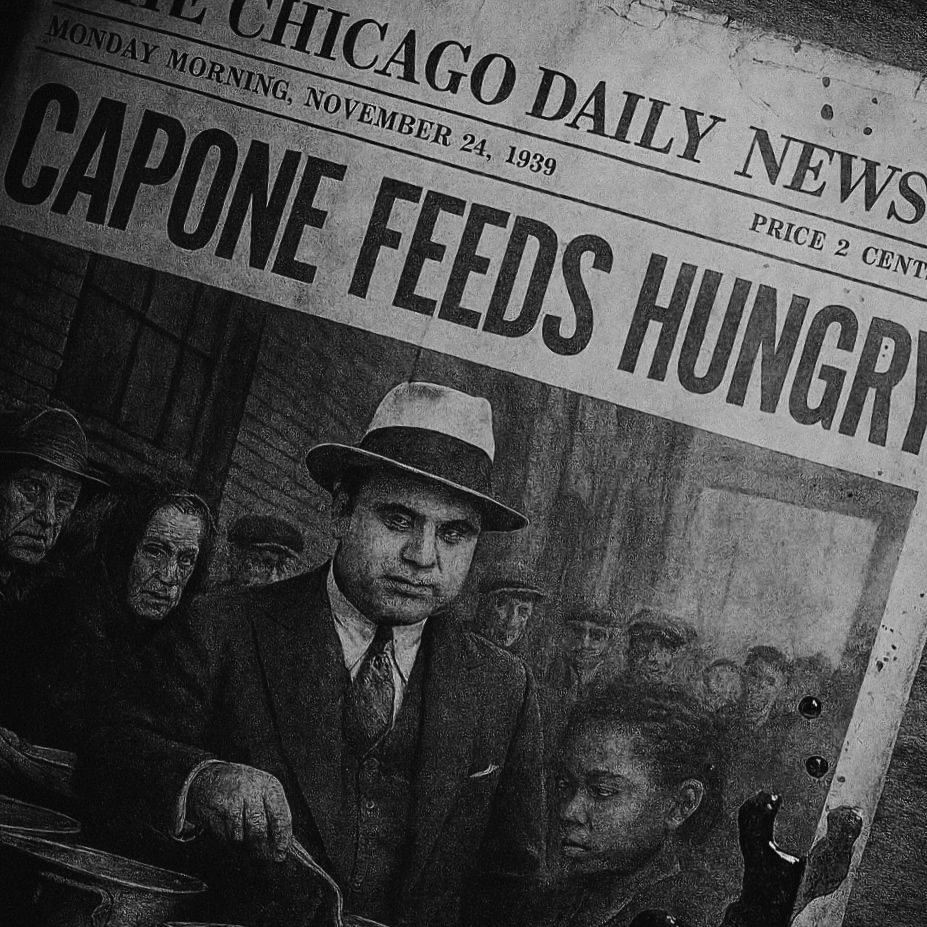
In the late 1920s and early 1930s, as the Great Depression tightened its grip on Chicago, the empire built on bootlegging and blood began to wear a second mask. The man at the center of it all understood that raw power alone could not secure loyalty; fear had to be tempered with gestures of charity. On one side of the city, his men collected debts, enforced silence, and kept rivals in check with ruthless precision. Violence was the language of control, and every shattered storefront or silenced enemy reminded Chicago who truly ruled its streets. Yet on the other side, soup kitchens opened under his patronage. Hungry families lined up for bread and hot meals, and newspapers carried stories of a gangster who fed the poor when the government could not. This paradox was deliberate. By cultivating a Robin Hood image, he blurred the line between villain and benefactor. To the desperate, he was a provider; to the fearful, he was a tyrant. The duality made him untouchable: the same man who ordered assassinations also ensured children did not starve. The press played its part, fascinated by the contradiction. Headlines painted him as both menace and savior, a figure larger than life. Politicians and police, already compromised by bribes, found themselves powerless against a man who commanded not only fear but also gratitude. Behind the curtain, the empire remained unchanged, liquor flowed through hidden doors, gambling dens thrived, and rivals disappeared. But in public, the image of charity softened the brutality, allowing the legend to grow. Chicago was not just ruled by force; it was ruled by myth.
CHAPTER 05 -
Steel & Silk (Style and Symbolism)

As the empire grew, so too did its need for spectacle. Power was not only enforced in backrooms and alleys, it was displayed in every stitch of clothing, every gleam of metal, every puff of smoke curling from a cigar. The gangster understood that fear was most effective when dressed in elegance. He wore flashy suits cut from the finest fabrics, pinstripes sharp enough to slice through the gloom of Depression‑era streets. Diamond rings caught the light as he signed deals, a silent reminder that wealth flowed through his hands. The cigar became a symbol of dominance, slow, deliberate, and impossible to ignore. But nothing embodied the persona more than the bulletproof Cadillac. Sleek, imposing, and untouchable, it was more than a car; it was a fortress on wheels, a declaration that even violence could not pierce his reign. When the Cadillac rolled down the avenue, it was both parade and warning, a moving emblem of gangster chic. This style was not vanity alone. It was armor and theater, a way to project invincibility. The suits and jewels told the poor that their benefactor was untouchable, while the Cadillac told rivals that bullets would never end the story. Every detail was calculated: the cut of a lapel, the shine of a shoe, the glint of a watch. In time, the look itself became cultural influence. Young men mimicked the swagger, the tilt of the hat, the roll of the cigar. The gangster’s image seeped into films, fashion, and music, shaping the mythology of power. He was not just feared, he was imitated. Thus, style became symbolism. The empire was not only built on liquor and silence, but on the spectacle of wealth and menace. The gangster chic was more than appearance; it was a language, a code, a promise that the Shadow Saint would remain larger than life.
CHAPTER 06 -
Silence for The Fearless (Infamous Violence)

They said Chicago had two seasons: winter and war. And in 1929, war wore a fedora and smoked Cuban cigars. The streets were slick with bootleg liquor and blood, and Alphonse Capone didn’t just walk through them, he orchestrated them like a jazz conductor with a Tommy gun tucked under his coat. The morning of February 14th was cold, but the garage on North Clark Street was colder. Seven men lined up like dominoes, waiting for a deal that never came. Two fake cops walked in, two shadows followed, and the walls lit up with gunfire. No shouting, no mercy, just the rhythm of bullets and the silence that follows. Capone was in Florida, sipping whiskey and smiling. He didn’t need to be there. His name was enough. The city understood: this was a message written in blood, signed with style. But violence wasn’t always brutal. Sometimes it wore silk gloves and played piano. One night, Capone’s men snatched Fats Waller off the street, not for ransom, but for rhythm. They brought him to a party, handed him champagne, and told him to play. Fats laughed, played all night, and left with pockets full of cash and a story no one would believe. That was Capone’s way: menace wrapped in velvet, a birthday party with a side of kidnapping. By the early thirties, Capone wasn’t just feared, he was myth. Politicians whispered his name like a curse, cops took his money and called it survival, and the public watched him like a movie star. He dressed like royalty, dined like a diplomat, and ruled like a ghost. His empire ran on bootleg liquor, but his power came from reputation. He didn’t need to shout. He just needed to arrive. And when he did, the room changed. The air thickened. The music slowed. People smiled too wide or not at all. Because Capone didn’t just kill, he curated fear. He turned violence into theater, and Chicago was his stage.
CHAPTER 07 -
Sonny's Lullaby (Family and Private Life)

Mae Coughlin had married Al in 1918, the same year their son Albert Francis, Sonny, was born. From that moment forward, she was his wife, his confidante, and the quiet figure who stood apart from the noise of his world. Where others saw a man of menace, Mae saw the husband who returned home with a tenderness reserved only for her and their boy. Sonny was fragile in hearing but strong in spirit. Al’s devotion to him was absolute. He feared not the rivals who plotted against him, nor the bullets that echoed in alleys, but the possibility that his son might inherit the shadow of his name. To protect him, Al built walls of silence around their private life. The mansion in Florida became a sanctuary, a place where Mae kept the curtains drawn and Sonny played in gardens untouched by the violence that defined his father’s empire. At home, Al was transformed. The preacher’s cadence and the gangster’s glare dissolved into something softer. He bent low to catch Sonny’s laughter, and he listened when Mae spoke in her quiet, measured way. He wanted them to believe in safety, in music, in the ordinary rhythm of family life, even as the world outside trembled under his reputation. Mae understood the bargain. She would never ask about the men who came and went, never question the money stacked in envelopes, never demand explanations for the headlines that carried her husband’s name. Her role was to preserve the illusion, to keep the family untouched. And she did, with loyalty that endured even through his decline. When illness stripped Al of his power, Mae remained. She nursed him through the fog of disease, through the years when his mind faltered and his body betrayed him. Sonny, grown and determined to escape the shadow of his father, changed his name and built a life far from notoriety. He married, raised daughters, and lived in anonymity, as if to prove that the Capone legacy could be rewritten in silence. In the end, the paradox of Al’s life was clearest in his family. To the world, he was a figure of fear, a man whose reputation was carved in blood. But to Mae and Sonny, he was simply husband and father, flawed, devoted, desperate to protect them from the very empire he had created.
CHAPTER 08 -
Numbers Don't Lie (The Law Closes In)

The city had long whispered that Capone was untouchable. He had survived assassination attempts, bribed officials, and walked free from charges that would have buried lesser men. Yet behind the scenes, investigators from the Bureau of Revenue were combing through ledgers, receipts, and coded accounts. They weren’t chasing murders or bootlegging shipments, they were chasing unpaid taxes. By 1931, the evidence was ready. Capone had failed to pay income tax on vast sums earned from gambling, racketeering, and smuggling. The government indicted him on twenty‑two counts of tax evasion, covering the years 1925 through 1929. The trial began in Chicago on October 6, 1931, presided over by Judge James H. Wilkerson. Capone’s lawyers tried to negotiate, offering to plead guilty in exchange for a lighter sentence. But Wilkerson refused to play along. In a dramatic move, he switched out the jury panel at the last moment, replacing one suspected of bribery with a fresh group. Capone’s confidence faltered. On October 17, 1931, the verdict was delivered: guilty on five counts of tax evasion. The sentence was severe, eleven years in federal prison, a fifty‑thousand‑dollar fine, and thirty‑thousand in court costs. For a man who had ruled Chicago’s underworld, it was a stunning collapse. Capone was led away, no longer the untouchable kingpin but a convicted felon. The law had found its weapon not in guns or raids, but in the tax code. His empire, built on intimidation and secrecy, had been dismantled by paperwork.
CHAPTER 09 -
Ledgers of Time (Behind Bars)

At first, prison life in Atlanta seemed almost like a retreat. The walls were high, but inside them Al lived with a certain ease. He had money, influence, and a name that carried weight even behind bars. His cell was modest, but his days were softened by privileges: decent meals, friendly guards, and a routine that felt more like exile than punishment. For a man who had ruled Chicago’s streets, Atlanta was a cage, but not yet a torment. But the government had learned from its mistakes. Comfort was not the justice they sought. In 1934, Al was transferred to the brand‑new fortress of Alcatraz, “The Rock”. Here, the air was colder, the walls thicker, and the guards immune to reputation. No favors, no bribes, no whispered deals. Alcatraz was designed to break men who thought themselves untouchable. Yet even here, he found ways to endure. He took up the banjo, plucking out tunes that echoed through the stone corridors, a strange soundtrack to his fall from power. He played chess with other inmates, moving pawns and knights with the same calculation he once applied to his empire. The games were quiet, deliberate, a reminder that strategy still mattered, even when the board was only wood and pieces. The Rock stripped away the glamour, but it did not erase the man. Al was no longer the king of Chicago, but he was still Al, stubborn, resourceful, and oddly dignified in defeat. His life behind bars became a paradox: a gangster humbled by arithmetic, now a prisoner who found solace in music and games.
CHAPTER 10 -
The Last Mile (Decline and Legacy)

The final act was not a courtroom, nor a prison, but the slow erosion of mind and body. Syphilis, untreated for years, had crept into his brain, reducing him to a childlike state. The man who once calculated empires and commanded armies of enforcers now struggled with memory, with words, with the simplest tasks. His mind, once sharp and ruthless, became fragile, wandering, diminished. Florida became his last stage. The sun was warm, the air heavy, and the days passed in strange simplicity. He fished in quiet waters, lines cast without strategy, more pastime than pursuit. He wandered the grounds in a bathrobe, detached from the world that had once feared his name. The banjo was silent now; the chessboard abandoned. What remained was a figure adrift, a man emptied of the power that had defined him. Yet even as his body and mind declined, his image grew. Newspapers, films, and radio carried his legend. Writers and directors turned him into a symbol, the gangster as myth, the outlaw as icon. His name became shorthand for excess, for crime, for the allure of forbidden power. In popular culture, he endured far beyond his own capacity, transformed into a character larger than life. The irony was complete: the man himself diminished, but the myth immortal. History remembered not the bathrobe or the fishing pole, but the swagger, the trials, the ledgers, the banjo on The Rock. His decline was private, almost tender in its smallness. His legacy was public, vast, and enduring. And so the ledger closed. Time had balanced the account, reducing the man to frailty, yet leaving behind a mythology that would echo for generations. The story ended in Florida, but the legend marched on, a reminder that power fades, but myth endures.